Example Slot Signal
- Example Slot Signal Circuit
- Example Slot Signal Definition
- Example Slot Signal Device
- Example Slot Signal Bar
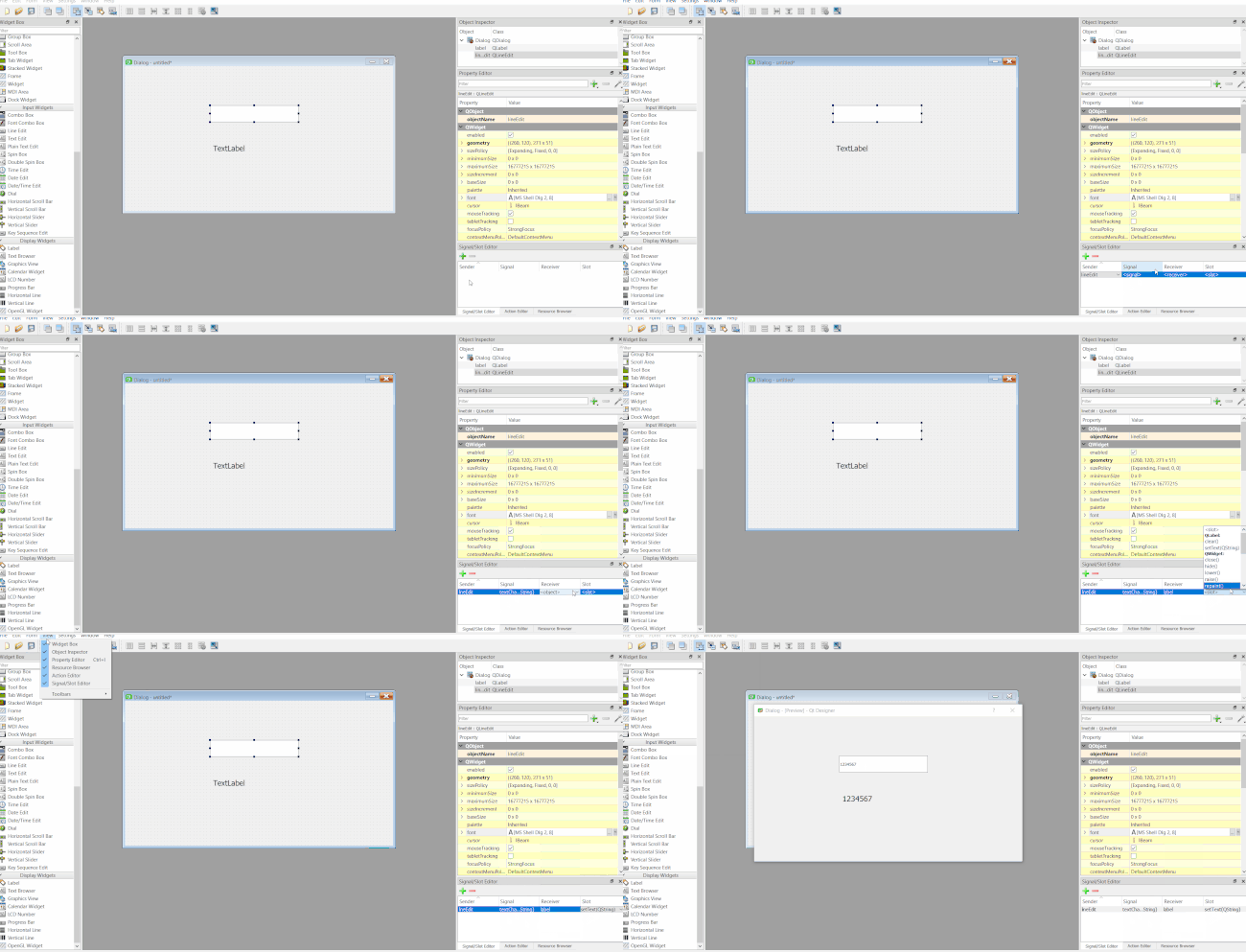
An example of using signals and slots For example, the use of signals and slots project was created, which in the main window contains three buttons, each of which is connected to the slot and these slots already transmit a signal in a single slot with the pressed button number. Project Structure. In this case, the signal slot connections are set automatically. In QML, you can connect and disconnect signal / slot connections using the following syntax: object1.signal.connect (object2.slot) object1.signal.disconnect (object2.slot) Signals in QML can also be connected to other signals, as is done in Qt / C. The signal on its own does not perform any action. Instead, it is ‘connected’ to a ‘slot’. The slot can be any callable Python function. In PyQt, connection between a signal and a slot can be achieved in different ways. Following are most commonly used techniques − QtCore.QObject.connect(widget, QtCore.SIGNAL(‘signalname’), slot.
QPushButton ('Manually connected', self) self. AddWidget (self. Manbtn) # Manually connect the clicked signal to it's handler, as we have done # in other examples self. Manbtn, QtCore. SIGNAL ('clicked'), self. Manualslot) # Create a button which we will automatially connect to a slot self. Brokenbtn = QtGui. Similarly, the signal/slot system can be used for other non-GUI usages, for example asynchronous I/O (including sockets, pipes, serial devices, etc.) event notification or to associate timeout events with appropriate object instances and methods or functions.
Qt5 alpha has been released. One of the features which I have been working on is a new syntax for signals and slot.This blog entry will present it.
Here is how you would connect a signal to a slot:
What really happens behind the scenes is that the SIGNAL and SLOT macros will convert their argument to a string. Then QObject::connect() will compare those strings with the introspection data collected by the moc tool.
What's the problem with this syntax?
While working fine in general, we can identify some issues:
- No compile time check: All the checks are done at run-time by parsing the strings. That means if you do a typo in the name of the signal or the slot, it will compile but the connection will not be made, and you will only notice a warning in the standard output.
- Since it operates on the strings, the type names of the slot must match exactly the ones of the signal. And they also need to be the same in the header and in the connect statement. This means it won't work nicely if you want to use
typedefor namespaces
In the upcoming Qt5, an alternative syntax exist. The former syntax will still work. But you can now also use this new way of connecting your signals to your slots:
Which one is the more beautiful is a matter of taste. One can quickly get used to the new syntax.
So apart from the aesthetic point of view, let us go over some of the things that it brings us:
Compile-time checking
You will get a compiler error if you misspelled the signal or slot name, or if the arguments of your slot do not match those from the signal.
This might save you some time while you are doing some re-factoring and change the name or arguments of signals or slots.
An effort has been made, using static_assert to get nice compile errors if the arguments do not match or of you miss a Q_OBJECT
Arguments automatic type conversion
Not only you can now use typedef or namespaces properly, but you can also connect signalsto slots that take arguments of different types if an implicit conversion is possible
In the following example, we connect a signal that has a QString as a parameter to a slot that takes a QVariant. It works because QVariant has an implicit constructor that takes a QString
Connecting to any function
Example Slot Signal Circuit
As you might have seen in the previous example, the slot was just declared as publicand not as slot. Qt will indeed call directly the function pointer of the slot, andwill not need moc introspection anymore. (It still needs it for the signal)
But what we can also do is connecting to any function or functor:
This can become very powerful when you associate that with boost or tr1::bind.
C++11 lambda expressions
Everything documented here works with the plain old C++98. But if you use compiler that supportsC++11, I really recommend you to use some of the language's new features.Lambda expressions are supportedby at least MSVC 2010, GCC 4.5, clang 3.1. For the last two, you need to pass -std=c++0x asa flag.
You can then write code like:
This allows you to write asynchronous code very easily.
Example Slot Signal Definition
Update: Also have a look what other C++11 features Qt5 offers.
It is time to try it out. Check out the alpha and start playing. Don't hesistate to report bugs.
Signals and slots is a language construct introduced also in Qt[1] for communication between objects which makes it easy to implement the observer pattern while avoiding boilerplate code. The concept is that GUI widgets can send signals containing event information which can be received by other widgets / controls using special functions known as slots. This is similar to C/C++ function pointers, but signal/slot system ensures the type-correctness of callback arguments.[citation needed]
The signal/slot system fits well with the way graphical user interfaces are designed.[citation needed] Similarly, the signal/slot system can be used for other non-GUI usages, for example asynchronous I/O (including sockets, pipes, serial devices, etc.) event notification or to associate timeout events with appropriate object instances and methods or functions. It is easy to use and no registration/deregistration/invocation code need to be written, because Qt's metaobject compiler (MOC) automatically generates the needed infrastructure.
A commonly used metaphor[according to whom?] is a spreadsheet. A spreadsheet has cells that observe the source cell(s). When the source cell is changed, the dependent cells are updated from the event.
Alternative implementations[edit]
There are some implementations of signal/slot systems based on C++ templates, which don't require the extra metaobject compiler, as used by Qt, such as libsigc++, sigslot, vdk-signals, nano-signal-slot, neosigslot, Signals, boost.signals2, Synapse, Cpp::Events, Platinum and JBroadcaster. Common Language Infrastructure (CLI) languages such as C# also supports a similar construct although with a different terminology and syntax: events play the role of signals, and delegates are the slots. Another implementation of signals exists for ActionScript 3.0, inspired by C# events and signals/slots in Qt. Additionally, a delegate can be a local variable, much like a function pointer, while a slot in Qt must be a class member declared as such. The C based GObject system also provides similar functionality via GSignal.In D it is implemented by std.signals.
See also[edit]
Libraries[edit]
Java: sig4j - multi-threaded, type-safe, based on the FunctionalInterface annotation introduced in Java 8.
Example Slot Signal Device
C++: vdk-signals - thread-safe, type-safe, written in C++11 with atomic variables.
References[edit]
- ^'Signals & Slots - QtCore 5.1'. Qt Project. 2013-07-04. Retrieved 2013-07-04.